|
HERE YOU CAN READ MORE GERRARD NEWS
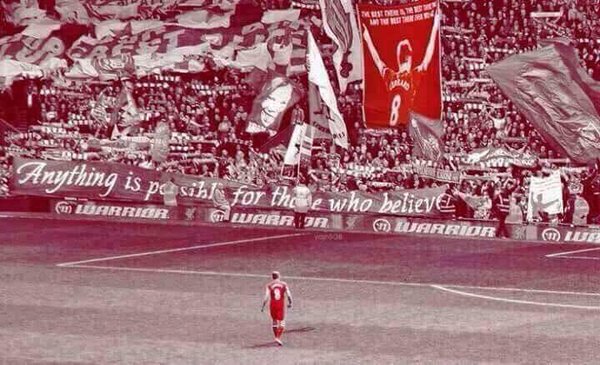
Aged 14, Gerrard had trials with various clubs, including Manchester United. In his autobiography he claimed that this was “to pressure Liverpool into giving me a YTS contract.” During this time he had an accident involving a rusty garden fork and could have lost his toe. Gerrard signed his first professional contract with Liverpool on 5 November 1997. He was paid £700 a week 1998–99: Debut season 1999–00: First team regular Gerrard replaced Robbie Fowler after 66 minutes but went on to receive the first red card of his career for a foul on Everton’s Kevin Campbell in the 90th minute. Later that season, Gerrard scored his first senior goal in a 4–1 victory over Sheffield Wednesday. His back was causing him regular problems. At the time, many journalists [who?] surmised that fans would never see Gerrard complete anything close to a full season. However, manager Gerard Houllier took the practical approach and sought specialist help. After visits to the renowned sports consultant Müller-Wohlfarth, it was diagnosed that Gerrard’s pains were a result of accelerated growth in a short period of time. After treatment he and Liverpool F.C. were assured that these problems would not recur. Gerrard then suffered from groin problems. He was said to need four operations for this correction. He then saw Liverpool F.C. doctors and kept his faith with Liverpool. He was sent to a Frenchman for his treatment by Gérard Houllier. He worked hard to recover and soon his groin injuries were no longer a problem. It had also been claimed that because of a 3 inch growth in his height during one year that the growth in his body caused many of the problems. In his early career it was said by some that it was impossible for him to play two games a week. 2000–01: The “treble” season In the UEFA Cup final against Alavés, Gerrard scored his first major final goal as Liverpool won 5–4. At the end of the season Gerrard was named PFA Young Player of the Year. 2001–02: Growing influence During the course of this season, Houllier suffered serious health problems which resulted in him having to undergo major heart surgery. At this point Liverpool looked like becoming a force in English Football once again, but after Houllier’s illness the team began to go backwards. The team’s performance became increasingly erratic and reliant on Gerrard and Michael Owen to win matches with flashes of inspiration. 2002–03: League cup winner Gerrard claimed in his autobiography that the end of his parents marriage had deflected his attention from the team. Gerrard quickly recovered from this poor spell and once again began to assert sizeable influence on the team. The season culminated in a series of outstanding performances from Gerrard, which included him scoring the first goal in Liverpool’s 2–0 Worthington Cup final victory over fierce rivals Manchester United. 2003–04: Captain of Liverpool His then Liverpool team mate, Michael Owen, in his autobiography expressed relief at Gerrard being named captain as it took the pressure off him. Gerrard also penned a four-year contract worth £60,000 a week. However, while Gerrard excelled as Liverpool’s captain, the team continued to stall and the 2003–04 season ended with no trophies and a lack of optimism about Liverpool’s future prospects for success under Houllier. For the first time it was suggested [who?] that Gerrard may have to move away from Anfield to fulfill his potential. The previous season had seen Liverpool fall well short of competing for top prizes and they only just scraped into a Champions League place on the last day of the league season. The Liverpool board decided that change was essential and Gerard Houllier departed as manager. This led to frenzied media speculation that Gerrard would also leave Anfield, but the appointment of Rafael Benitez convinced him to stay to see what the new manager could deliver. 2004–05: Champions League Winner A foot injury sustained against rivals Manchester United on 20 September 2004 ruled Gerrard out of first team football until late November 2004. By that stage the club were already out of realistic contention in the Premier League and they were also under pressure to stay in the Champions League. Liverpool went into the final group game requiring a two-goal win to progress into the last 16 of the competition. Gerrard scored a 25-yard strike in the last five minutes against the Greek team Olympiakos to secure the team’s progress, after being 1–0 down at half-time to a Rivaldo free kick and required three second half goals to go through. Liverpool had been struggling for goals after Owen’s sale and Cisse’s injury. However, they launched a comeback scoring 2 goals before Gerrard secured their place in the knockout stage with the crucial third goal with a late strike from outside the box. He has since claimed that this was his most important, if not his best, goal for Liverpool to date. Liverpool won their two-legged ties against Bayer Leverkusen, Juventus and Chelsea in the knock out stages and they went on to reach the Champions League final. However, in the meantime, the club only finished 5th in the league – more than thirty points behind the champions Chelsea. Liverpool did reach the Carling Cup final, but were beaten 3–2 by Chelsea after extra time. Gerrard headed an own goal with Liverpool winning with ten minutes left of normal time. This proved to be one of the lowest points of his Anfield career and once again, media speculation arose that he would be moving on from Liverpool at the end of the season. Final in Istanbul During a six minute stretch in the second half, Liverpool scored three times to level the game at 3–3. Gerrard headed in the first goal in from a John Arne Riise cross in the 54th minute. Two minutes later Vladimír Šmicer scored the Reds’ second goal. Moments later, Gerrard was brought down in the box by Gennaro Gattuso and won a penalty. Xabi Alonso’s spot kick was saved by Dida, the goalkeeper, but he failed to hold the ball and Alonso scored from the rebound to make it 3–3. There were no further goals in the game. Liverpool went on to win the match via a penalty shootout. Gerrard became the second youngest captain ever to lift the European Cup (Didier Deschamps is the youngest). Gerrard did not take a penalty, he would have taken Liverpool’s fifth spot kick if Jerzy Dudek had not already saved from Andriy Shevchenko to win the match for Liverpool. Gerrard’s goal made him one of only two people this century to score in both the UEFA Cup and Champions League finals (Dmitri Alenichev for FC Porto is the other). Gerrard was named as UEFA’s Most Valuable Player for the 2004–05 Champions’ League season. He was also in the running for French sport newspaper L’Equipe’s prestigious Ballon D’Or award. Gerrard came third in the 2005 BBC Sports Personality of the Year behind Ellen MacArthur (second) and Andrew Flintoff. He later finished third in the 2005 European footballer of the year award. 2005–06: FA Cup winner Gerrard capped the season by captaining Liverpool to victory in the FA Cup. He scored twice in the Final against West Ham, including an equalizer in stoppage time to send the game into extra-time. The 35-yard strike (past Shaka Hislop) has been called the greatest goal in FA Cup final history, and was named Match of the Day’s Goal of the Season. Gerrard also scored in the penalty shoot out. His goals in the 2006 FA Cup final makes Gerrard the only player to have scored in all four major cup finals that it is possible for an England-based player to take part in. Gerrard’s goals were: FA Cup (2006 vs West Ham United), League Cup (2003 vs Manchester United), UEFA Cup (2001 vs Deportivo Alaves), and European Cup (2005 vs AC Milan). 2006–07: Champions League Runners-Up Liverpool were unsuccessful domestically. They finished 3rd in the Premiership, 21 points adrift of the champions Manchester United and on equal points with 4th placed Arsenal. In the FA Cup, they were defeated by Arsenal at the third-round stage. In the Carling Cup they were again knocked out by Arsenal at the quarter-final stage. Gerrard scored in the match but could not prevent his side suffering a 6–3 defeat at home. However, Liverpool fared better in the Champions League. Defending Champions and favourites FC Barcelona were beaten in the last 16, and joint favourites Chelsea in the semi-final. In the semi, Gerrard provided the assist for Daniel Agger to score Liverpool’s equalizer and later scored the third penalty for Liverpool in the shoot-out. Liverpool faced AC Milan for the title on 23 May, in a repeat of the 2005 final, but lost 2–1. 2007–08 In the Champions League qualifier versus Toulouse F.C., Gerrard was substituted in the 65th minute with a suspected injury. While this was later confirmed as a hairline fracture in his toe he would return to play only four days later versus Chelsea. Gerrard played the entirety of the match as it finished in a 1–1 draw. On October 28, 2007, Gerrard played his 400th game for Liverpool against Arsenal, scoring a goal. Gerrard was elected fans player of the match. Gerrard scored in nearly every game [quantify] during November and by scoring in the away Champions League tie against Olympic Marseille he became the first Liverpool player since John Aldridge in 1989 to score in 7 games in a row. On April 13th 2008 he made his 300th Premier League appearance against Blackburn Rovers F.C., and marked the occasion by scoring the opening goal. Liverpool finished fourth in the League and reached the semi-finals of the European Champions League eventually going out to Chelsea. Gerrard ended the season with 22 goals surpassing his goals total of the 06-07 season and was one of the nominees for the PFA player of the year alongside teammate Fernando Torres. He was also selected for the PFA Team of the year for the fifth year in a row and sixth overall. International career Gerrard was one of three Liverpool players including Michael Owen (3 goals) and Emile Heskey (1 goal) who scored in the World Cup qualifying game in September 2001 against Germany (1– 5 away victory), this being his first international goal. England successfully qualified for the 2002 World Cup, but Gerrard was forced to pull out of the squad to undergo surgery on a problematic groin injury.This operation finally put an end to injury problems that had plagued Gerrard since his early teens. The 2004 European Football Championship saw Gerrard finally get a starting role in a major international tournament. Late in England’s first game against France, Gerrard’s back-pass was intercepted by Thierry Henry, who was then brought down by David James, winning France a penalty. Zinedine Zidane duly scored to give France victory 2-1. England went on to win their next two group games to progress in second place, with Gerrard scoring his first goal at a finals competition with the third goal against Switzerland. England lost in the next round to Portugal, with Gerrard being substituted in the 81st minute. Gerrard suffered an injury scare days before the 2006 World Cup in Germany, when it was suggested that he might be ruled out of England’s first game of the tournament; however, he was deemed fit to make his first ever World Cup appearance, and started in the side that beat Paraguay 1-0. He then went on to score twice in the group stages of the tournament – first netting England’s second goal in a 2-0 victory over Trinidad & Tobago with a long-range, curled strike (coincidentally, again past Hislop) in injury time. This victory, in which Gerrard’s Liverpool team-mate Peter Crouch also scored, ensured England’s progress to the second round of the tournament with a game to spare. Gerrard was then initially rested for the final group game against Sweden, as a precaution against picking up a second booking that would have ruled him out of the second round match (having already received one against Paraguay). He came off the bench to score a powerfully headed goal in the 85th minute, giving England the lead in a game that finished 2-2. Gerrard was one of three England players to see their penalty saved by Ricardo Pereira in the quarter-final penalty shoot-out which was won by Portugal. Gerrard finished the tournament as England’s top goalscorer with two goals. Gerrard was regarded by both the footballing media and bookmakers to be one of the prime candidates for the England captaincy after David Beckham resigned the post. William Hill gave odds of 2/1 for Gerrard (with John Terry as favourite on 1/2 odds). With 47 caps at that time, Gerrard was a more experienced international player (as opposed to Terry’s 29), but Steve McClaren chose to give the post to the Chelsea skipper, with Gerrard as vice-captain. On October 13, 2007, Gerrard captained the England squad for the first time in a competitive match. Due to England failing to qualify for The European Championships in 2008, Steve McClaren was fired by the F.A. Fabio Capello was hired and is responsible for deciding who the captains arm band will be given to. (Wikipedia, the free encyclopedia) 2008 2009 May: Gerrard named the 2009 Football Writers’ Association Footballer of the Year. July 8: Gerrard has put pen to paper on a new four-year contract that will ensure he remains at Liverpool for the rest of his career. 2010 |
 ერთად ვუყუროთ ფეხბურთს